
Figure 1 The partnership pentagram
Charles Boelen1, Paul Grand’Maison2, Somaya Hosny3, and Karen Flegg4
1MD, DPH, MSc, International consultant in health systems and workforce, former Coordinator of WHO Human Resources for Health., France
2MD, MSc, Emeritus Professor and Associate Professor, Department of Family Medicine and Emergency Medicine, Faculty of Medicine and Health Sciences, Université de Sherbrooke, Sherbrooke, Canada
3MD, PhD, MHPE, Former Dean, Professor, Department of Physiology, Faculty of Medicine, Suez Canal University, Ismailia. Egypt
4MBBS, MIPH, President of WONCA, Asssociate Professor, Rural Clinical School, Australian National University, Canberra, Australia
ABSTRACT
There is a growing worldwide concern about the capacity of health systems to effectively address both current and future health needs and challenges faced by societies and individuals. The key players in this context, referred to here as “health stakeholders”, must reconsider how they can enhance their response to health needs in society. This paper introduces a conceptual framework grounded on principles of social accountability that is designed to help stakeholders critically assess their contributions. The framework supports the alignment of stakeholder missions and actions with evolving social needs and enables the evaluation of their impact on population health and well-being.
The uniqueness of this framework lies in its starting point: it prioritizes relevant broad features of health in a society rather than beginning with the stakeholder itself and its conferred mandate. This shift in focus enhances the relevance and effectiveness of the dynamic interplay between health in society and various stakeholder roles. The three-gradients stepwise approach of social accountability put forward encourages and guides each stakeholder through a progressive and continuous journey of quality improvement, moving through three stages of awareness, transformation and measurable impact.
The application of this framework offers health stakeholders an opportunity to update and develop more relevant quality indicators and accreditation standards at the institutional level. The presented example of medical schools can be extended and applied to other stakeholders. The framework should enable all of them to assess their contribution to health, identify pathways for improvement and strengthen their social accountability. Avenues for further research and development projects are identified.
Key Words: Social accountability, Assessment, Health stakeholders, Accreditation standards
Date submitted: 1-March-2025
Email:Paul Grand’Maison (paul.grandmaison@usherbrooke.ca)
This is an open access journal, and articles are distributed under the terms of the Creative Commons Attribution-Non Commercial-Share Alike 4.0 License, which allows others to remix, tweak, and build upon the work non-commercially, as long as appropriate credit is given and the new creations are licensed under the identical terms.
Citation: Grand’Maison P, Boelen C, Hosny S, and Flegg K. Assessing and enhancing health stakeholders’ impact on people’s health using a social accountability conceptual framework. Educ Health 2025;38:166-175
Online access: www.educationforhealthjournal.org
DOI: 10.62694/efh.2025.236
Published by The Network: Towards Unity for Health
Health systems worldwide face significant challenges in addressing the priority health needs of citizens and communities. Despite decades of efforts, many health systems still fall short in meeting these needs, leaving gaps in access, coverage, relevance, efficiency, equity, and quality of care. These shortcomings are often exacerbated by the rapidly changing landscape of health determinants influenced by demographic, educational, economic, cultural, political, environmental and climate factors. Health systems are constantly challenged to better align their strategies, practices and services with changing or emerging needs and priorities in any given society.
By applying principles of social accountability, a better alignment of stakeholders’ actions as a response to priority health needs and challenges can be expected. This paper proposes a conceptual framework grounded in the concept of social accountability as a pathway to assess and enhance stakeholders’ impact on health in a society, providing a structured approach to drive systemic change to improve health systems and thus people’s health.
Health systems consist of all the people, institutions, and actions aiming to promote, restore, and maintain health.1 Health stakeholders such as policymakers, health administrators, health professionals, academics and their institutions, plus communities, occupy a unique position in any health system to respond to health needs as confirmed in the last progress report of the United Nations Sustainable Development Goals initiative.2
Persistent inefficiencies within health systems frequently result from a gap between health needs and stakeholders’ actions. They also result from a failure to convince stakeholders to be less preoccupied by their internal agendas and to work together around a unity of vision. At their best, health systems should function as interconnected networks, leveraging synergetic expertise, resources and actions of various stakeholders to achieve shared goals based on people’s priority health needs.3 (Figure 1).
Figure 1 The partnership pentagram
The efforts of a single stakeholder are unlikely to produce sustainable outcomes unless other key stakeholders engage in similarly aligned actions and coordinated activities, and unless their interventions are mutually reinforcing.
It is strongly recommended that national policymakers actively invite and encourage all major health stakeholders to undertake an essential introspective process on how they could better respond to priority health needs within the society they serve. They should also provide them with appropriate incentives, material, organizational guidance and strategic support, both nationally and regionally, to have them envision and implement meaningful reforms and efficient partnerships within their respective territories.
This paper proposes a conceptual framework as a platform for health stakeholders to assess their respective roles, align their efforts and actions with health priorities, and to work collaboratively. In doing so, they may be challenged to go beyond their traditional working realms.
Social accountability in health is broadly defined as the commitment to identify and respond to health priorities and needs in a society to be served by all stakeholders, and to ensure that actions yield meaningful outcomes.
Derived from the WHO’s initial definition of the social accountability of medical schools4 and after numerous consultations and experiences from the field, a more comprehensive definition has been suggested by the International Francophone Network for Social Accountability in Health (RIFRESS) resting on three key pillars5 (Figure 2).
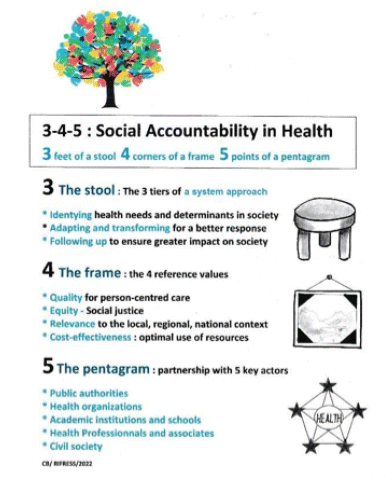
Figure 2 Social accountability in health (RIFRESS)
The first pillar emphasizes a systemic and problem-solving approach encompassing identification of health needs, transformations to address them effectively and sustainably, and subsequent follow up for outcomes and impact. The second pillar highlights four health system core values—equity, quality, relevance, and cost-effectiveness, as essential and interrelated beacons for guiding stakeholders’ missions. The third pillar underscores the necessity of strong partnerships, recognizing that no single actor can address complex health challenges in isolation.
At the heart of social accountability in health is the relationship between society in general and its stakeholders in health. This relationship is dynamic and reciprocal. On one hand, society exists with decisions to make on protecting and improving people’s health. On the other hand, stakeholders exist with their invested mandates. An innovative feature of this framework is its emphasis on the most relevant features of health in society as the primary entry point, rather than beginning with the profile and characteristics of any given stakeholder. This leads to a more comprehensive understanding of the full spectrum of health needs in society, and of the possible required stakeholders’ actions, as well as the dynamic interplay between the two. Even though Figure 3 illustrates a reciprocal relationship, vector A should conduct the flow. “Health in Society” is the first component of the framework. It focuses on broad features for health: population profile, health policies and priorities, service delivery systems and workforce.
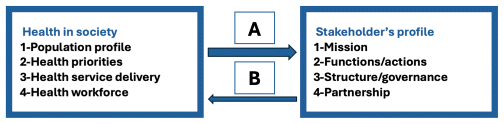
Figure 3 The interplay between health in society and stakeholder’s profile
“Stakeholder Profile” is the second component of the framework. It focusses on stakeholders’ mission, functions and actions, structure and governance, as well as partnerships.
Even though each society, and each stakeholder, has their own unique features, the content of component 1 and component 2 presented here is a relevant skeletal outline. This outline works to characterize any society concerned with the health of its people, as well as to depict the general status of any stakeholder, (being a governmental decision-maker, a health administrator, an academic institution, an association or group of professionals, and a community). The number and precision of sections and subsections of component 1 and component 2 may vary depending on_the regional or national context. An expanded version of component 1, Health in Society is presented in Table 1 as an example.
Table 1 Component 1. Health in society.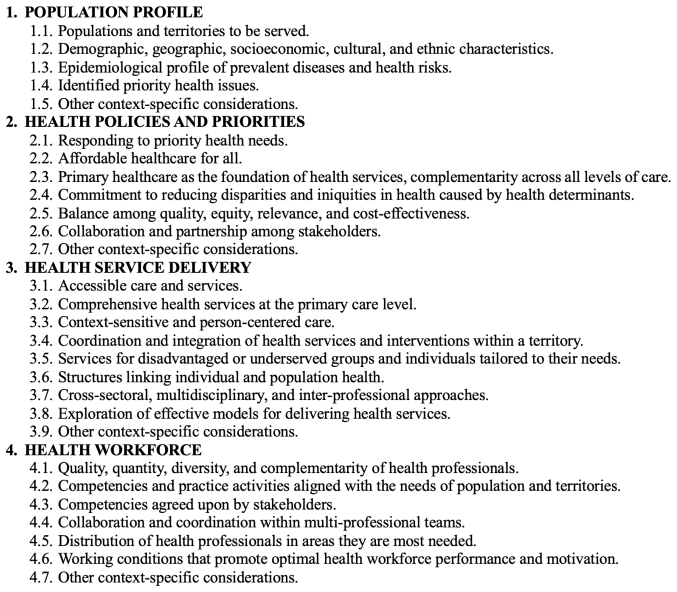
The whole conceptual framework includes three more components and is illustrated in its entirety in Figure 4.
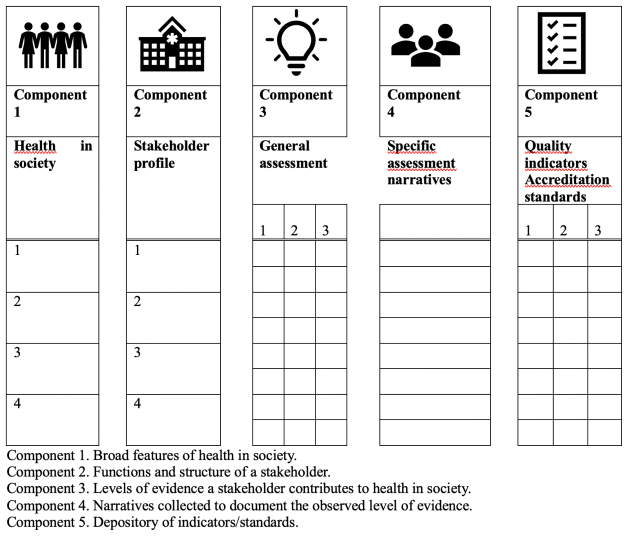
Figure 4 A conceptual framework grounded on social accountability to derive quality indicators and accreditation standards for health stakeholders
Any stakeholder is invited to observe the unique interactions between Health in Society issues and its own profile. Analyzing this interplay allows an initial assessment (component 3) of the stakeholder’s response to priority health needs and its contribution to health. The assessment is categorized into three levels considering the intermediate nuances of social accountability.6 The three levels are as follows:
The three-gradient stepwise approach offers (at least) two advantages. Firstly, it recognizes that what a stakeholder has so far achieved, and how modest it may appear, is a step in the right direction giving confidence to pursue its efforts and actions. Secondly, it inspires the development of indicators and measurement tools for each gradient of social accountability, offering stakeholders directions for further evolutionary steps to become more socially accountable.
The fourth component of the framework is an invitation to its users to elaborate narratives detailing the observed evidence for one of the three levels attributed.
Out of the analysis made throughout the first four components, component 5 evolves as a depository of formal indicators and measurement tools reflecting one of the three levels of social accountability. Accreditation organizations should find it useful to translate such indicators as standards.
The distinctive features of this conceptual framework are summarized here. It puts upfront Health in Society issues as its primary entry point. It considers all the missions and functions of any stakeholder, instead of limiting itself to one of them. It emphasizes the progressive nature of the path to greater social accountability. It stresses the identification of quality indicators, or standards, matched to these three gradients.
It points out that these indicators could (and should) be adopted, and adapted to their context, by accreditation organizations as standards—what should lead to and warrant long term movement and effect. It highlights partnerships without which no sustainable impact can occur. Authors argue that without taking into account all these features and their complementarity, changes and effective results would be more limited and fragile.
The authors decided to make medical schools an example in order to apply the proposed conceptual framework, for both some objective and subjective reasons. To our knowledge, medical schools form a stakeholder group that has had the longest acquaintance with the concept of social accountability, being urged over the years to embrace its principles7,8,9 and to consider them in their accreditation standards and processes.10,11,12 It is also the stakeholder that authors know best, while their experience with others is limited.
Table 2 presents a detailed profile for a medical school addressing component 2. Elements of this profile are derived from procedure manuals of best-known accreditation systems. Worth noting are some included functions going further than educational functions, and less frequently put forward, such as population to be served, governance, contribution to health services, research, partnership.
Table 2 Component 2: Medical Schools’ Profile (Functions and Structure).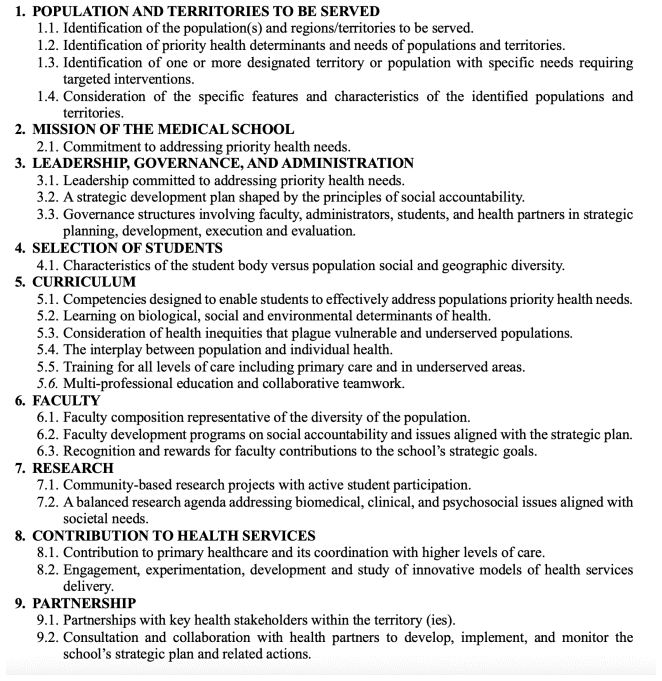
An example of how the structured approach of this conceptual framework could be used for a hypothetical medical school is presented in the following paragraphs. Its relative simplicity is intended to ensure that the utilization of the framework is well understood. No matter how simple it may appear, the example covers all the distinctive features of the framework presented in the preceding section, including the consideration of the three missions of medical schools: education, research and services. Its simplicity, and at the same time its comprehensiveness, should facilitate readers to derive lessons from it.
In this example, the user initially identifies one priority issue of health in society, and analyzes how the medical school aligns different elements of its profile to better respond to it. From this analysis, the user assigns a level of social accountability and supports his or her assignment by mentioning relevant narratives. Finally, he or she suggests hints for accreditation standards, respectively, to the three levels of social accountability.
Services for disadvantaged or underserved populations tailored to their needs. (Item 3.5 in Table 1)
Contribution to health services. (Item 8 in table 2)
Level 3. Impact
Students complete training activities with these populations. Faculty offer clinical services to them responding to their evolving needs. Researchers conduct work with and for these populations.
*Level 1 of SA: Awareness. The school targets specific disadvantaged or underserved populations in its territory and identifies their priority health needs.
*Level 2 of SA: Transformation. Faculty members develop and offer innovative need-oriented services to disadvantaged or underserved populations at first level of care. Medical students offer services to these populations through a clinical rotation that has been confirmed as mandatory by program leaders.
*Level 3 of SA: Impact. Partnering with public health, practicing professionals and patients coming from underserved populations, faculty members complete research projects on disadvantaged or underserved populations. One such project may be to assesses the impact of the aforementioned transformations on the health services offered to the targeted populations, as well as their impact on students’ attitudes towards providing services to similar populations in their future careers.
In building their own collection of standards, accreditation organizations would also benefit from consulting documents that propose indicators of social accountability from which standards can be derived.8,10,13,14,15,16 Applying these are likely to bring a change of their constituents’ ethics for better health in society.
Although the framework was initially developed with medical schools in mind and exemplified with them, its principles are broadly applicable to other health stakeholders, such as a regional health authority, a district hospital, a health centre, a health-related social service, a health practitioner, and other academic institutions. They all share a common responsibility: to address priority health challenges of the society they serve. They can all benefit from adopting social accountability as a guide to improving their contribution.
What follows are examples where such a trend is notable, even if we can hope for other developments.
The Canadian CanMEDS competency framework highlights the physicians’ roles. It confirms the necessary commitment to society and the responsibility to address community health needs; it promotes system-level change and advocacy for health.17 By further incorporating social accountability principles, CanMEDS reinforces the practice standards of physicians and other health professionals, as well as their ethics, regarding their response to the health care needs of the population.
The CPTS (“Communautés professionnelles territoriales de santé”) in France are networks of physicians and other health professionals who work together in a community centre offering services to a defined population in a specific geographical area.18 Designed to deliver a combination of health promotion, preventive and curative care services, they focus on access to care and better healthcare pathways for patients. They may benefit from the framework described here by appraising the need for better outreach services for disadvantaged populations, and for increasing coordination and partnerships with key stakeholders in the area for optimal fulfilment of their goal.
The CIVIS alliance, a network of European universities, may consider the framework as a tool to strengthen their multi-disciplinary approaches in education and research, and their wish to engage with communities to work on social changes that would improve people’s wellbeing.19
Puting forward social accountability in health as a benchmark of excellence will have a ripple effect on all health sector stakeholders and their engagement for better health.
As societies and health systems around the world face significant political, economic, cultural, and environmental changes that affect health and shape priority needs, it is essential that each stakeholder, whether operating at the national, regional, or local level, takes responsibility and embraces its ethical obligation to enhance its contribution to maintaining, and improving, the health of all its citizens.
The proposed conceptual framework, grounded in social accountability, is a practical and structured tool to sharpen consciousness for reflection, reform, innovation, engagement and continuous improvement that should ultimately benefit all citizens and their societies. It is hoped that the following expectations of the development of this framework will be reached:
First, that it would be used as a suitable instrument to support health stakeholders to go beyond good intentions and their present stance and move towards more practical and measurable achievements to better people’s health in the societies they serve.
Second, that health stakeholders monitor, in an effective way, their position in this venture as a basis for further continuous progress. Third, that the accreditation organizations of the different groups of stakeholders include, in their indicators of quality standards, that they are designed under the lens of social accountability.
Following are a few recommended actions:
National authorities should facilitate and support national, regional and local activities, both within and among groups of different stakeholders, to critically review their adhesion to social accountability principles and to envisage institutional changes in the scenarios in which they would work as partners in a given territory.
Information and capacity-building initiatives linked to the potential of the social accountability concept and principles to bring institutional transformative reforms for better responses to health care needs, should be made widely available to audiences of health leaders and stakeholders.
International studies examining the usefulness of the conceptual framework presented here should be undertaken, in order to provide valuable insights on best ways to proceed to enhance social accountability of health stakeholders, considering the specificity of their context and their openness. Accreditation bodies of health stakeholders should be consulted on their views regarding the potential offered by the concept of social accountability as a strategy to upgrade their standards for a better response of their members to the priority health needs of the people they serve.
1. World Health Organisation, (2000). The World Health Report 2000. Health systems: improving performance, Geneva. Iris.who.int/handle/10665/79020. Retrieved 2024-02-06
2. United Nations (2023). Times of crisis. Times of changes. Science accelerating transformation to sustainable development. United Nations Global Sustainable Development Report 2023. New York. https://desapublications.un.org/file/1182/download. Retrieved 2025-06-01
3. World Health Organization. (2000). Towards unity for health: challenges and opportunities for partnership in health development, a working paper/Charles Boelen. World Health Organization. Iris.who.int/handle/10665/66566. Retrieved 2024-02-06
4. Boelen C and Heck J E, World Health Organization. (1995) Division of development of Human resources for Health. Defining and measuring the social accountability of medical schools/Charles Boelen and Jeffrey E Heck. World Health Organization. Iris.who.int/handle/10665/59441. Retrieved 2024-04-03
5. RIFRESS, Réseau International Francophone pour la Responsabilité Sociale en Santé (International Francophone Network for Social Accountability in Health). https://rifress.umontreal.ca/ressources/articles-de-references/ Retrieved 2024-04-03
6. Boelen C and Woollard R (2011). Social accountability: the extra leap to excellence for educational institutions. Medical Teacher. 2011; 33(8): 614–619. https://doi.org/10.3109/0142159X.2011.590248.
Crossref PubMed
7. Gastel BA. (1995) Toward a global consensus on the quality of medical education: serving the needs of populations and individuals. Academic Medicine 15. 70 (7): p S73–75. PMID: 762616 https://doi.org/10.1097/00001888-199507000-00022
PubMed
8. GCSA. Global consensus for social accountability of medical schools. https://www.researchgate.net/publication/295165758_Global_consensus_on_the_social_responsibility_of_medical_schools. Retrieved: 2024-04-03
9. Frenk, J. et al. (2010). Health professionals for a new century: Transforming education to strengthen health systems in an interdependent world. The Lancet, 376, 9756, 1923 – 1958. https://doi.org/10.1016/S0140-6738(10)61854.-5
Crossref
10. Boelen C, Grand’ Maison P, Ladner J et Pestiaux D. Responsabilité sociale et accréditation. Une nouvelle frontière pour l’institution de formation. Pédagogie Médicale 2008 9(4): 235–244. https://doi.org/10.1051/pmed:2008368
11. Boelen C, Blouin D, Gibbs T, Woollard R. Accrediting excellence for a medical school’s impact on population health, Education for Health. 2019; 32(1): 41–48. https://doi.org/10.4103/efh.EfH_204_19
Crossref PubMed
12. International Social Accountability in Accreditation Steering Committee (ISAASC): https://www.arcandcentre.ca/research/isaasc Retrieved: 2024-04-10
13. The Network TUFH, THEnet, PAHO, Beyond Flexner Alliance. ISAT. Indicators for Social Accountability Tool in Health Profession Education (2018). https://socialaccountabilityhealth.org/. Retrieved 2024-04-10
14. Association of Medical Education in Europe (AMEE). ASPIRE recognition of excellence in social accountability of a medical school. Social-Accountability-Criteria.pdf Retrieved 2025-06-01
15. Boelen C, Pearson D, Kaufman A, Rourke J, Woollard R, Marsh D, Gibbs T. Producing a socially accountable medical school, AMEE Guide n° 109. Medical Teacher. 2016; 38(11): 1078–1091. https://doi.org/10.1080/0142159X.2016.1219029
Crossref PubMed
16. THEnet. Framework for Socially Accountable Health Workforce Education. https://thenetcommunity.org/the-framework/ Retrieved: 2024-04-10
17. Frank JR, Snell L, Sherbina J, (Eds). CanMEDS 2015 Physician Competency Framework. Ottawa: Royal College of Physicians and Surgeons of Canada, 2015. https://canmeds.royalcollege.ca/en/framework Retrieved: 2025-06-01.
18. CPTS system, France. CPTS: s’organiser sur un même territoire pour renforcer les soins aux patients https://sante.gouv.fr/systeme-de-sante/structures-de-soins/cpts-s-organiser-sur-un-meme-territoire-pour-renforcer-les-soins-aux-patients. Retrieved: 2024-06-18
19. CIVIS. European Civic University Alliance https://civis.eu/en. Retrieved: 2024-06-18
© Education for Health.
Education for Health | Volume 38, No. 2, April-June 2025