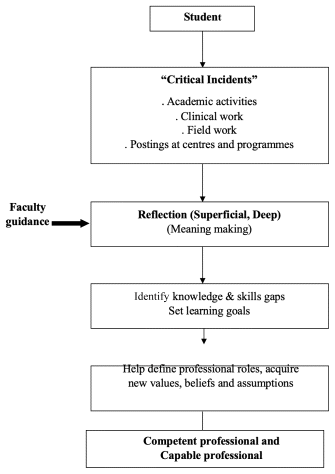
Figure 1 Summary of steps to professional capability through reflective practice in public health programs
Amol Dongre1, Pradeep Deshmukh2, and Himanshu Pandya3
1MD (Comm Med), MPS, MHPE, Professor of Community Medicine, Sri Manakula Vinayagar Medical College and Hospital, Pondicherry, India
2MD (Comm Med), Professor and Head, Department of Community Medicine, All India Institute of Medical Sciences, Nagpur, India
3MD, Dean, Professor of Medicine and Medical Education, Pramukhswami Medical College, Bhaikaka University, Anand, India
ABSTRACT
This review article explores the integration of reflective practice into public health postgraduate training programs to enhance the professional capabilities of students. It emphasizes the significance of experiential learning in authentic settings, followed by reflection that fosters professional identity formation. This article also discusses the benefits of reflective practice, such as enhanced self-awareness, empathy, and professional identity formation. Based on the existing literature, this review proposes eight steps to effectively utilize reflective practice, including faculty training, identifying critical incidents for reflection, and guiding self-reflection. It also highlights the challenges in developing and sustaining reflective practice, including motivating and training faculty, building mutual trust, ensuring its continuity and carrying out robust impact evaluations. Despite these challenges, fostering a culture of reflection in public health practice is essential for developing competent and capable public health professionals.
Key Words: Reflection, capability, post-graduate, public health
Date submitted: 30-January-2025
Email:Amol Dongre (cm.amol@smvmch.ac.in)
This is an open access journal, and articles are distributed under the terms of the Creative Commons Attribution-Non Commercial-Share Alike 4.0 License, which allows others to remix, tweak, and build upon the work non-commercially, as long as appropriate credit is given and the new creations are licensed under the identical terms.
Citation: Dongre A, Deshmukh P, and Pandya H. Integrating reflective practice into public health postgraduate programs to develop professional capabilities. Educ Health 2025;38:176-183
Online access: www.educationforhealthjournal.org
DOI: 10.62694/efh.2025.273
Published by The Network: Towards Unity for Health
According to the World Health Organization, public health is defined as “the art and science of preventing disease, prolonging life, and promoting health through the organized efforts of society.”1 Use of the term ‘art’ reflects the need for practical, adaptable, and creative approaches in addressing challenges. Similarly, health professions education must focus on developing professional competence through meaningful experiential learning and reflection, fostering professional identity and growth.2
In public health, professionals often face complex problems in diverse contexts. Delivering good health care in this context demands not just competence but capability – the ability to adapt, innovate and continuously improve.3 Constructive feedback and exposure to unfamiliar situations enhances this capability.3 Research highlights that workplace-based reflective practice improves the practitioners’ capabilities, leading to better patient outcomes.4,5 Schön emphasized the importance of reflection-in-action, a critical component for refining professional practice when existing theories are insufficient.6,7
This review explores how faculty can utilize reflective practice to nurture the professional identity and capabilities of postgraduate students. Building on existing literature, it aims to highlight the relevance of reflective practice and outlines actionable steps for its application in the training of public health students.
Reflection is a process in which thoughts are ‘turned back’ to make meaning from experiences. It is defined as “a metacognitive process that occurs before, during, and after situations to develop a greater understanding of self and situation so that the future encounters with similar situations are informed.”8 This introspection informs future actions. Understanding ‘self’ builds self-efficacy (confidence) and understanding the ‘situation’ helps define and develop one’s professional roles and responsibilities.
The reflection cycle consists of three steps: 1) plan, 2) do, and 3) review.8 Notably, this aligns with widely quoted Kolb’s experiential learning cycle:9 1) active experimentation, 2) getting experience by doing it, 3) reflecting on the experience gained, 4) abstract conceptualization of learning by making meaning out of it. Experiential learning builds knowledge, skills, and self-awareness through reflection, enhancing readiness for future challenges. Notably, the reflective practice plays a crucial role in achieving higher levels of Bloom’s Taxonomy, particularly in the cognitive domains of analysis, synthesis, and evaluation.10
According to Piaget’s theory,11 reflection-in-action helps students develop a mental schema (framework) suitable to practice in the given context. In practical terms, it helps students accommodate diverse perspectives, enhance positive emotions, develop problem-solving abilities, and understand their roles as professionals.8
Existing literature shows that reflective practice offers some short-term benefits to students such as enhancement in their self-awareness, being self-directed, improving grades, benefits in summative assessment and development in empathy.12 Personal reflection was found to improve moral reasoning ability among students, develop emotional intelligence and convert stress into more positive emotion.13
Continued reflective practice yields long-term benefits both in Professional Identity Formation (PIF) and professional capabilities.14,15 PIF is a complex and transformative process of internalizing a profession’s core knowledge, skills, values, and beliefs resulting in an individual who thinks, acts, and feels like a member of a professional community.16 This transformation occurs during the process of socialization, as learners’ personal identities evolve into professional identities. This evolution is shaped, both consciously and unconsciously, through the influence of mentors and role models.17 Finally, deep reflection can play a key role in bridging the gap between Inner Development Goals—such as being, thinking, relating, collaborating, and acting, with outer Sustainable Development Goals focused on health and environmental well-being.18
The following steps have been suggested for initiating reflective writing practice within the constraints of the postgraduate curriculum of public health programs, typical exposures in the field of public health, and recent publications in the field of reflective practices:19,20 Figure 1 presents key steps in a visual format.
Figure 1 Summary of steps to professional capability through reflective practice in public health programs
Faculty should be aware of several key aspects of reflective practice, including its purpose, frameworks, methods of reflection, their role as mentors, and how to assess student reflections.21 The reflective practice can be seamlessly integrated into their routine teaching or public health work. It can also be included as a component of the performance appraisal system, providing faculty with the opportunity to gain practical experience in reflective practice where they gain practical experience of it while developing their own perspectives and methods of reflection.
The purpose of reflective practice in public health encompasses both personal and professional development. Its purpose is to build the capabilities required to achieve higher public health goals such as health promotion and disease prevention, addressing social determinants and promoting equity, and finally developing a resilient healthcare system for universal health coverage. Achieving these higher goals require not only technical expertise but also profound self-awareness and critical thinking, which can be cultivated through the process of deep reflection. To enable ‘deep reflection’, departments or universities should collaboratively choose focus areas and models for reflective practice. Notably, reflective frameworks contribute to comprehensiveness, supporting the development of practices, as well as assessment and evaluation plans.
Designing reflective practice programs requires collaboration and co-operation between students and faculty. To ensure support and address operational challenges, it is crucial to involve other stakeholders, such as administrators and members of the medical education unit. Sustained commitment from all stakeholders is necessary to achieve meaningful and lasting outcomes.
The program can begin with student and faculty volunteers and gradually expand through iterative cycles of action, reflection, and improvement. Faculty can also incorporate informal reflective sessions into the existing curriculum by incorporating informal reflective sessions. For example, Boyle et al. introduced the concept of the ‘reflective café’ as a pedagogical tool, involving three sessions spread across an academic year, where students share their reflective stories in a supportive and confidential environment.22
Such approaches can be adapted to public health education by leveraging informal student-teacher interactions during field visits, retreat meetings, post-survey de-brief, team huddles, story-telling sessions, peer sharing and informal chats during formal events etc. These moments offer valuable opportunities to integrate reflective practice, fostering deeper insights into community health issues in the context, and possible solutions.
A critical incident approach involves identifying key moments, where students experience ‘success’, ‘failure’ or significant learning opportunities. Proper planning is essential for this approach, as it provides valuable insights into what strategies were effective and what areas require improvement.23
Identifying critical incidents with clear boundaries of ‘success’ and ‘failure’ can be challenging, as public health practice often involves long-term processes, such as developing programs, monitoring and evaluation, or training healthcare workers for service delivery. Therefore, it may be practical to start with critical incidents related to routine academic activities, such as field visits, workshops, journal clubs, seminars, case presentations, health education sessions, or outbreak investigations.
Students should revisit the identified critical incidents and evaluate them objectively by responding to specific, open-ended questions (Table 1). This structured approach promotes focused and meaningful reflection while ensuring that the workload remains manageable. Encouraging students to reflect on their strongest or weakest performances in these activities allows them to derive valuable lessons and insights. However, requiring reflection on every activity could lead to fatigue for both students and faculty. To mitigate this, opportunities and incidents for reflection should be carefully chosen, thoughtfully integrated into the curriculum, and systematically scheduled within students’ training programs.
Table 1 Reflective open-ended questions
Reflective practice can be introduced to students by emphasizing the immediate benefits, such as being self-directed, and benefits in assessment grades. Over the period, to retain their commitment, they may be incrementally sensitized to their professional roles and responsibilities to achieve higher goals of public health practice. Reflection methods such as storytelling, digital recordings, verbal narratives, and PowerPoint presentations are particularly suitable. These methods allow students to explore and articulate their experiences in meaningful ways.
Immediate student-faculty interaction is crucial for aiding incident recall; therefore, protected time should be allocated for this purpose and explicitly included in the curriculum and timetable. During these interactions, faculty should actively encourage students to move beyond superficial questions and engage in deep, reflective discussions. Faculty can help students to relate their findings to self, family, and community. This approach helps students analyze situations critically, derive deeper insights, set meaningful learning goals, foster a sense of commitment, and clarify their professional purpose.
Faculty-driven reflective questions should challenge students’ underlying values, assumptions, and beliefs, aligning their reflections with their evolving professional roles. For instance, Table 2 highlights examples of superficial versus deep questions in the context of a vaccination campaign. These examples demonstrate the use of positive, tailored questions—a method shown to stimulate deeper-level reflection and enhance students’ understanding.24
Table 2 Superficial and deep reflective questions for various stages of Kolb’s cycle for the given scenario
Students should document and compile evidence of their academic work and reflections, as this process supports both personal growth and program evaluation. It is suggested that to enhance the impact of reflective practice, students should be encouraged to write in the first person rather than the third person. As noted by Charon and Hemann, the act of writing itself cultivates the skills of reflection.25 Recording reflections on the same day enhances recall and provides a foundation for systematic thinking. This approach facilitates a more personal, introspective, and engaging learning process, ultimately enriching their professional development in public health.26
Reflection documentation can also occur asynchronously through online platforms, offering flexibility and accessibility.27 Similarly, electronic health records have been explored as valuable tools for learning and reflection.28 By documenting their reflections systematically, students can effectively track their progress while contributing to the overall evaluation of training programs.
The purpose of the assessment is to evaluate competence and provide formative feedback. However, assessing reflections can be challenging for faculty and may feel uncomfortable for students. The literature suggests focusing on the depth of reflections. A reflection is considered superficial when it merely describes the incident, whereas it is deemed deep if it delves into implicit meanings, challenges underlying beliefs, and evaluates implications for practice. Moon has proposed a practical approach through a grading rubric, which can be contextually adapted to suit specific assessment goals.29 The Grading Reflective Essays (GRE) scale, consisting of nine items, is a concise, user-friendly, and reliable tool for evaluating reflective essays, with demonstrated moderate to substantial inter-rater reliability.30 However, its potential application in public health education remains to be explored, particularly for grading reflective essays that capture students’ extended exposure to programs or field experiences.
Research on reflective practice has primarily focused on identifying themes in students’ descriptions,31 analyzing student and faculty perceptions of reflections,32 and developing assessment rubrics.30,33 Additionally, text-data mining software has been used to examine the learning experiences of Japanese students31 and analyze linguistic patterns in language used by students in Taiwan.34 The use of text-data mining software for qualitative data analysis remains underexplored in routine public health practice and education, where quantitative analytic approaches continue to dominate in shaping interpretations and guiding decisions.
The first challenge lies in motivating and training both students and faculty to develop a culture of reflective practice. Another significant difficulty involves building mutual trust and fostering a safe educational environment where students feel comfortable expressing their experiences, views, and opinions. Encouraging faculty to act as role models by demonstrating and integrating reflective practice into their professional activities adds complexity, particularly since it is often a non-visible process.
Once initiated, identifying critical incidents in public health practice often involves longer processes, and presents an additional challenge. Sustaining reflective practices and conducting periodic evaluations to ensure continuous improvement are crucial steps. In the absence of contextual evidence, advancing research to longitudinally measure outcomes—especially those that are largely intangible—emerges as a particularly intricate and demanding task.
Based on the existing literature, we propose eight steps for developing reflective practice in public health programs. Considering its numerous benefits, despite the several challenges, it appears to be a promising approach for fostering a culture of reflection in public health practice and for developing competent and capable public health professionals.
1. Health P. WHO Definition of Public Health - Public Health. 2020.https://www.publichealth.com.ng/who-definition-of-public-health/ (Accessed 22 March 2025).
2. Hutchinson T, Smilovitch M. Experiential Learning And Reflection To Support Professionalism And Professional Identity Formation. Second Edition. Cambridge: Cambridge University Press;
3. Fraser SW, Greenhalgh T. Coping with complexity: educating for capability. BMJ (Clinical Research Ed.) 2001;323(7316):799–803. https://doi.org/10.1136/bmj.323.7316.799.
Crossref PubMed PMC
4. Walsh P, Owen PA, Mustafa N, Beech R. Learning and teaching approaches promoting resilience in student nurses: An integrated review of the literature. Nurse Education in Practice 2020;45:102748. https://doi.org/10.1016/j.nepr.2020.102748.
Crossref PubMed
5. Jantzen D. Refining nursing practice through workplace learning: A grounded theory. Journal of Clinical Nursing 2019;28(13–14):2565–2576. https://doi.org/10.1111/jocn.14841.
Crossref PubMed
6. Schon DA. The Reflective Practitioner: How Professionals Think In Action. San Francisco: Ca: Jossey-Bass.; 1983.
7. Schon DA. Educating the Reflective Practitioner. Toward a New Design for Teaching and Learning in the Professions. San Francisco, CA: Jossey-Bass; 1987.
8. Sandars J. The use of reflection in medical education: AMEE Guide No. 44. Medical Teacher 2009;31(8):685–695. https://doi.org/10.1080/01421590903050374.
Crossref PubMed
9. Kolb D. Experiential Learning: Experience as the Source of Learning and Development. Englewood Cliffs: NJ: Prentice Hall.; 1984. http://academic.regis.edu/ed205/Kolb.pdf
10. Bloom BS. Taxonomy of Educational Objectives: The Classification of Educational Goals. Handbook I: Cognitive Domain. David McKay Company.; 1956.
11. Piaget J. Cognitive Development in Children: Development and Learning. Journal of Research in Science Teaching 1964;2(3):176–186.
Crossref
12. Chen I, Forbes C. Reflective writing and its impact on empathy in medical education: systematic review. Journal of Educational Evaluation for Health Professions 2014;11:20. https://doi.org/10.3352/jeehp.2014.11.20.
Crossref PubMed PMC
13. Kim H-S, Jeong H-W, Ju D, Lee J-A, Ahn S-H. Development and Preliminary Evaluation of the Effects of a Preceptor Reflective Practice Program: A Mixed-Method Research. International Journal of Environmental Research and Public Health 2022;19(21):13755. https://doi.org/10.3390/ijerph192113755.
Crossref PubMed PMC
14. Gustafsson C, Fagerberg I. Reflection, the way to professional development? Journal of Clinical Nursing 2004;13(3):271–280. https://doi.org/10.1046/j.1365-2702.2003.00880.x.
Crossref PubMed
15. Glod SA, Richard D, Gordon P, Fecile ML, Kees-Folts D, Kreher M et al. A Curriculum for Clerkship Students to Foster Professionalism Through Reflective Practice and Identity Formation. MedEdPORTAL: The Journal of Teaching and Learning Resources 2016;12:10416. https://doi.org/10.15766/mep_2374-8265.10416.
Crossref PubMed PMC
16. Cruess RL, Cruess SR, Steinert Y. Teaching Medical Professionalism: Supporting the Development of Professional Identity. Second Edition. Cambridge: Cambridge University Press; 2016.
Crossref
17. Cruess SR, Cruess RL. The Development of Professional Identity. In: Understanding Medical Education. John Wiley Sons, Ltd; 2018. 978-1-119-37378-0.
Crossref
18. Ankrah D, Bristow J, Hires D, Artem Henriksson J. Inner Development Goals: from inner growth to outer change. The Journal of Field Actions 2023;(Special Issue 25):82–87.
19. van Oorschot F, Brouwers M, Muris J, Veen M, Timmerman A, Dulmen S van. How does guided group reflection work to support professional identity formation in postgraduate medical education: A scoping review. Medical Teacher 2024;:1–11. https://doi.org/10.1080/0142159X.2024.2339409.
20. Lim JY, Ong SYK, Ng CYH, Chan KLE, Wu SYEA, So WZ et al. A systematic scoping review of reflective writing in medical education. BMC Medical Education 2023;23(1):12. https://doi.org/10.1186/s12909-022-03924-4.
Crossref PubMed PMC
21. Boudreau JD, Liben S, Fuks A. A faculty development workshop in narrative-based reflective writing. Perspectives on Medical Education 2012;1(3):143–154. https://doi.org/10.1007/s40037-012-0021-4.
Crossref
22. Boyle C, Logan S, Lavery J. Evaluating the use of reflective cafés in Specialist Community Practitioner and Specialist Community Public Health Nurse programmes. British Journal of Community Nursing 2023;28(3):146–154. https://doi.org/10.12968/bjcn.2023.28.3.146.
Crossref PubMed
23. Alphonso CD. Reflection on a critical incident. Contemporary Nurse 2007;24(1):89–92. https://doi.org/10.5172/conu.2007.24.1.89.
Crossref PubMed
24. Dekker H, Schönrock-Adema J, Snoek JW, van der Molen T, Cohen-Schotanus J. Which characteristics of written feedback are perceived as stimulating students’ reflective competence: an exploratory study. BMC Medical Education 2013;13(1):94. https://doi.org/10.1186/1472-6920-13-94.
Crossref
25. Charon R, Hermann N. A Sense of Story, or Why Teach Reflective Writing? Academic Medicine : Journal of the Association of American Medical Colleges 2012;87(1):5–7. https://doi.org/10.1097/ACM.0b013e31823a59c7.
Crossref
26. Moon J. Introducing reflective activities to learners. In: Handbook of Reflective And Experiential Learning. Routledge; 2013.
Crossref
27. Pandit K, Chu DL, Russell R, Wright M, Titone L, Diaz T et al. The utility of an online discussion board for reflective writing in an emergency medicine rotation. AEM Education and Training 2023;7(4):e10899. https://doi.org/10.1002/aet2.10899.
Crossref PubMed PMC
28. Janssen A, Kay J, Talic S, Pusic M, Birnbaum RJ, Cavalcanti R et al. Electronic Health Records That Support Health Professional Reflective Practice: A Missed Opportunity in Digital Health. Journal of Healthcare Informatics Research 2023;6(4):375–384. https://doi.org/10.1007/s41666-022-00123-0.
Crossref PubMed PMC
29. Moon J. A Handbook of Reflective And Experiential Learning: Theory And Practice. London: Routledge Falmer; 2004.
30. Makarem NN, Saab BR, Maalouf G, Musharafieh U, Naji F, Rahme D et al. Grading reflective essays: the reliability of a newly developed tool-GRE-9. BMC Medical Education 2020;20(1):331. https://doi.org/10.1186/s12909-020-02213-2.
Crossref
31. Lebowitz A, Kotani K, Matsuyama Y, Matsumura M. Using text mining to analyze reflective essays from Japanese medical students after rural community placement. BMC Medical Education 2020;20(1):38. https://doi.org/10.1186/s12909-020-1951-x.
Crossref PubMed PMC
32. Sukhato K, Sumrithe S, Wongrathanandha C, Hathirat S, Leelapattana W, Dellow A. To be or not to be a facilitator of reflective learning for medical students? A case study of medical teachers’ perceptions of introducing a reflective writing exercise to an undergraduate curriculum. BMC Medical Education 2016;16(1):102. https://doi.org/10.1186/s12909-016-0624-2.
Crossref
33. Venugopal V, Dongre A, Kagne RN. Development of an analytical rubric and estimation of its validity and inter-rater reliability for assessing reflective narrations. The National Medical Journal of India 2023;36(5):323–326. https://doi.org/10.25259/NMJI_732_21.
Crossref
34. Lin C-W, Lin M-J, Wen C-C, Chu S-Y. A word-count approach to analyze linguistic patterns in the reflective writings of medical students. Medical Education Online 2016;21:29522. https://doi.org/10.3402/meo.v21.29522.
Crossref PubMed PMC
© Education for Health.
Education for Health | Volume 38, No. 2, April-June 2025