Brief Communication
Analysis of medical student regional profile data to advance social accountability
Jordyn N. Linders1, Sierra A. Land2, Kady Carr3, Geneviève Lemay4, and Claire E. Kendall5
1MSc, BHSc, Medical Student, Faculty of Medicine, University of Ottawa, Ottawa, Canada
2RN, BScN, Medical Student, Faculty of Medicine, University of Ottawa, Ottawa, Canada
3BA, MBA, Manager, Ottawa Neighbourhood Study, University of Ottawa, Ottawa, Canada
4MD, MSc, Assistant Dean of Admissions, Associate Professor of Medicine, Faculty of Medicine, University of Ottawa, Institut Savoir Montfort, Ottawa, Canada
5MD, PhD, Associate Dean, Social Accountability, Professor, Department of Family Medicine, Faculty of Medicine, University of Ottawa; Scientist, Bruyère Research Institute, Ottawa, Canada
Email:Jordyn N. Linders (jordyn.linders@uottawa.ca)
Date submitted: 14-March-2025
This is an open access journal, and articles are distributed under the terms of the Creative Commons Attribution-Non Commercial-Share Alike 4.0 License, which allows others to remix, tweak, and build upon the work non-commercially, as long as appropriate credit is given and the new creations are licensed under the identical terms.
Citation: Linders J, Land S, Carr K, Lemay G, and Kendall C. Analysis of medical student regional profile data to advance social accountability. Educ Health 2025;38:164-165.
Online access: www.educationforhealthjournal.org
DOI: 10.62694/efh.2025.299
Published by The Network: Towards Unity for Health
What problem was addressed?
Medical schools, including the University of Ottawa Faculty of Medicine, are increasingly committed to addressing social accountability through their admissions processes and curriculum. Evidence suggests that medical graduates often choose to practice in areas where they grew up. Recognizing this, our admissions office has tailored the process to prioritize regional applicants and to ensure representation across our catchment region with the Regional Admissions Stream. To inform these efforts, we implemented the Regional Profiles Working Group, tasked with analyzing medical student and regional data to understand the contexts in which our student cohort grew up.
What was tried?
The Regional Profiles Working Group brings together diverse faculty, community representatives, and students with a mandate to identify and apply data that will advance social accountability in our admissions processes. Cochaired by the Associate Dean of Social Accountability and the Manager of Ottawa Neighbourhood Study (ONS),1 the group leverages ONS’s expertise in collecting, mapping and analyzing neighborhood-level data for informed health and social planning.1 This collaboration enabled the group to link the postal codes of our 2023 medical school cohort during high school attendance to regional demographic data. Through iterative discussion and feedback, the group developed and mapped the profile of our student body.
What lessons were learned?
We used a composite indicator of socioeconomic conditions to understand the neighborhoods in which our regional students grew up. Among the 183 students in our cohort, 74.9% were from our province of Ontario, though only 22.4% were from our designated priority region. Fewer than 5 students were from our regional rural communities or First Nations reserves. We found that 7.7% were from the neighboring province of Quebec, 9.3% from other Canadian provinces, and 8.2% attended high school outside of Canada. Of those who attended high school in Ottawa, only 28.2% were from neighborhoods in the two most socioeconomically disadvantaged quintiles, compared to 51.2% who grew up in the two most advantaged quintiles.
We plan to repeat these analyses with our 2024 MD cohort to assess the impact of our Regional Admission Stream. By incorporating extended data from the Ontario Medical Student Applicant Service Equity, Diversity, and Inclusion survey, we aim to compare additional demographic information of the cohort against our region. To support ongoing analysis and visualization of sociodemographic data, we will develop a Regional Profiles data dashboard, guiding continuous improvements in admissions processes and curriculum to better meet the needs of our population.
Funding
This study was funded by the Office of Social Accountability, Faculty of Medicine, University of Ottawa.
Conflicts of interest
There are no conflicts of interest to declare.
Ethics
This research was granted an ethics exemption from the Faculty of Medicine, University of Ottawa Research Ethics Board.
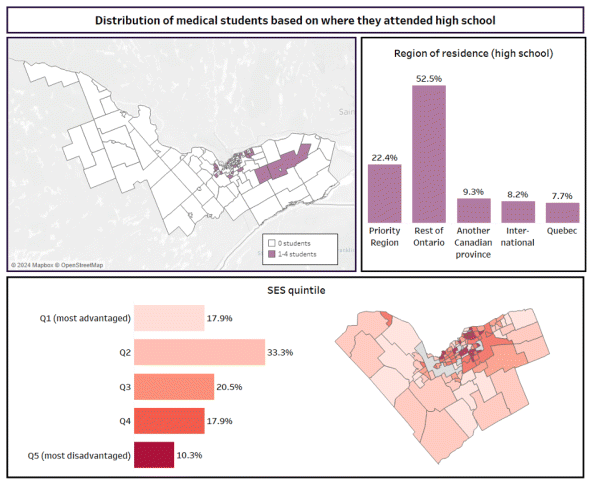
Figure 1 Geographic distribution of the University of Ottawa Faculty of Medicine MD program student cohort, based on where they attended high school. Socioeconomic status quintiles were pre-derived based on 6 variables, including unemployment rate, lone-parent families, residents aged 25–64 with no high school diploma, median market income, residents living in low-income, and households in core housing need.
References
1. ONS. (2024). Welcome to Ottawa Neighbourhood Study. Retrieved from https://www.neighbourhoodstudy.ca/ [Date of Access: March 14, 2025].
© Education for Health.
Education for Health | Volume 38, No. 2, April-June 2025
(Return to Top)