Amy Clithero-Eridon1, Ma Angelica Jeza Narvaez2, Simran Spal3, JE Wolvaardt4, Luke Chao5, William Burdick6
1PhD, MBA, Principal Lecturer, Department of Family & Community Medicine, University of New Mexico School of Medicine, Albuquerque, United States
2Medical student, University of New Mexico School of Medicine, Albuquerque, United States
3Intern, Punjab Institute of Medical Sciences, Jalandhar, India
4PhD, MPH, Professor, School of Health Systems and Public Health, University of Pretoria, Pretoria, South Africa
5Medical student, University of New Mexico School of Medicine, Albuquerque, United States
6MD, MSEd, Professor, Department of Emergency Medicine, Thomas Jefferson University, Sidney Kimmel School of Medicine, Philadelphia, United States
ABSTRACT
Background: The peer review process is widely accepted to benefit the education of health professionals. However, formal experience in peer reviewing is rare at the undergraduate level. A substantial pool of potential reviewers exists among health profession students, who are as rigorous in peer reviewing as those with more experience. In this study, we aimed to evaluate the impact of a mentorship experience designed to teach health professions students peer review skills using experienced peer reviewers as mentors.
Methods: Within the student organization section of The Network: Towards Unity for Health (SNO), student leaders hosted student-led journal clubs. Active SNO students were directly recruited and paired with experienced journal reviewers who served as their mentors. Each mentor/mentee pairing independently reviewed an article for either the journals Education for Health or Undergraduate Research in Health. They then met to discuss the results and provide feedback. Students who completed at least two reviews “graduated” from mentorship and were invited to join the pool of journal reviewers.
Results: The program effectively guided students to become effective peer reviewers. Students reported several benefits to participating in the program, including feeling more confident as peer reviewers, feeling more effective at delivering constructive feedback, and experiencing personal growth, such as becoming more effective at designing their research.
Discussion: A mentor/mentee peer review experience effectively produced a pool of competent peer reviewers while providing participants with several opportunities for personal growth. Ultimately, similar programs could lead to a larger community of peer reviewers and improved research literacy and capabilities among health professions students.
Key Words: peer reviewed publications, Allied health students
Email: Amy Clithero-Eridon (aclithero@salud.unm.edu)
Date submitted: 9-April-2025
This is an open access journal, and articles are distributed under the terms of the Creative Commons Attribution-Non Commercial-Share Alike 4.0 License, which allows others to remix, tweak, and build upon the work non-commercially, as long as appropriate credit is given and the new creations are licensed under the identical terms.
Citation: Clithero-Eridon A, Angelica Jeza Narvaez M, Spal S, Wolvaardt J, Chao L, and Burdick W. Medical students as journal reviewers: a project concept to consider them peers. Educ Health 2025;38:279-283.
Online access: www.educationforhealthjournal.org
DOI: 10.62694/efh.2025.321
Published by The Network: Towards Unity for Health
Academic journal policies vary on the subject of who can register as a peer reviewer. Some have “open reviews” where anyone can comment, while others, such as BMJ Open, welcome early-stage clinicians, including medical students, as reviewers and provide online training to guide them. Journals that solely publish undergraduate or student work often allow student peer review; however, it is rare for this skill to be taught at the undergraduate level. One example is where a journal club was repurposed to teach medical students to serve as peer reviewers for the Canadian Medical Education Journal.1 Health professions students, such as medical students, are a rich potential pool of reviewers for suitable journals, as research has shown that they are as stringent as more experienced reviewers.2 The experience can also prepare them to become established peer reviewers. There is literature on the benefits of peer review in health professions education, but little is known about using health professions students as peer reviewers in journals.3,4
The most noteworthy bottleneck in journal publishing is finding reviewers. The editors of two academic journals, one an international journal dedicated to medical education and community health improvement, and the other a South African journal designed for publishing the work of health professions students, decided to address this bottleneck by expanding their reviewer pools. The strategy was to teach participating students peer review skills using an apprenticeship approach, with experienced peer reviewers serving as mentors. The goals of this project are (1) for students to learn to give constructive feedback; (2) to write academically by reviewing manuscripts submitted to the journals; and (3) to respond professionally to feedback. We hypothesized that discussing feedback on jointly reviewed submissions with experienced reviewers would enable novice reviewers to produce accurate, clearly expressed, and useful reviews for authors, as well as make recommendations for acceptance, rejection, or revision.
Medical students were directly recruited from the student organization linked to The Network Towards Unity for Health, which comprises students from various health professions worldwide. The international research coordinator of the student network organization led these journal clubs. The sign-up link for the journal club was shared at least 15 days in advance with the topic and the paper to be discussed. A sign-up form was released, and registered users were emailed the link and the paper. Student leaders hosted these studentled journal club discussions to gauge interest in peer review before the start of the program. Each journal club required a three-month commitment. Students who attended at least three sessions and actively participated were eligible for the peer review program. The discussions in the journal club covered a range of topics, including qualitative studies, quantitative studies, meta-analyses, and systematic reviews.
An apprenticeship approach was used, as it is a hands-on, on-the-job, practical approach to learning that combines observation, practice, and feedback. Two published reviewing guidelines were used as pre-reading.5,6 The names of the most active students were selected by the international research coordinator and forwarded to the editor-in-chief of the Education for Health journal, who paired students with experienced peer reviewers. Experienced peer reviewers were selected by personal invitation from the editor-in-chief and were all regular reviewers for the journal. This helped ensure consistency in preparation and the feedback provided, as reviewers have access to the student’s preparation materials and guidelines for review. Each student/reviewer mentor pairing independently reviewed an article selected by the editors of either Education for Health or Undergraduate Research in Health journals. Each pair then discussed their reviews before submitting individual reviews. Some pairs submitted their reviews and then met to discuss recommendations. Students who completed at least two reviews with a mentor “graduated” from the mentorship. They could continue with the mentorship if they did not feel ready to submit an independent review. Mentor tutors remain available to answer questions via email after the completion of the mentorship. Students deemed prepared by the mentors are invited to join the pool of reviewers of one or more participating journals.
As a pilot program, we did not conduct a formal summative analysis. Instead, we gathered results from the student participants to improve the quality. We summarized them using a qualitative methodology approach, inductively identifying themes from student feedback in the pre- and post-assessments. We collected feedback for quality improvement purposes, and thus, no IRB approval was necessary.
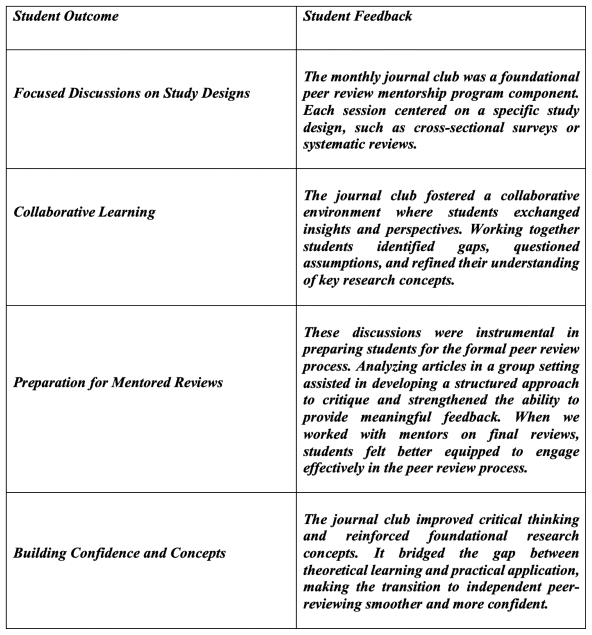
Regardless of how the pairings approached reviewing their assigned manuscripts, the reviewers deemed both beneficial for student learning. See Table 1: Outcomes of preparing students using a journal club design as reported by the student mentees.
Table 1 Outcomes of preparing students using a journal club design as reported by the student mentees
While faculty and students identified different elements for comment, they also noted similar issues, resulting in comprehensive assessments. Faculty advice for improving reviews included:
One of the most important lessons learned was delivering constructive feedback concisely, covering important points. Feedback must identify gaps or weaknesses and offer clear and actionable suggestions, ensuring they are respectful and practical.
Reviewing a manuscript for the first time, students initially felt the need to comment on every aspect of the paper, which led to overly detailed feedback. However, observing how mentors structured their reviews taught them how to prioritize key points and focus on the most significant aspects of the manuscript.
Comparing reviews with mentors was particularly enlightening. While comments often addressed different areas, they complemented each other, resulting in a comprehensive assessment. For example, students sometimes overlooked the mentor’s ability to identify structural issues, encouraging them to think more broadly during subsequent reviews.
This mentorship transformed the students’ understanding of peer review. All student participants felt more confident in their ability to evaluate manuscripts independently and make meaningful contributions to the academic community. An important skill commonly reported to have been developed by students was the ability to define a question and present measurable outcomes or results clearly and concisely. This improved their confidence in designing their projects and writing their manuscripts.
Peer review is not a new concept for students, as they often engage in peer-to-peer activities. These activities improve critical literature evaluation skills, strengthen communication and writing skills, and bolster motivation and perceived self-competency in literary analysis.7–9 Although students are not considered “peers” of faculty, many articles have students as authors, and many students have published papers, which should qualify them as journal reviewers with the proper guidance and training. Barriers for students to serve as reviewers may include time constraints, a lack of incentives and recognition, and limited access to mentorship, which can hinder their participation. Understanding these barriers is essential for designing peer review experiences that are both effective and engaging for students. It is critical to address student concerns about their ability to provide concise, professional, and polite reviews. For example, receiving harsh feedback can inhibit students’ confidence in publishing their work. Thus, teaching them how to conduct a manuscript review benefits them by strengthening their understanding of academic writing standards and facilitating a balanced approach to criticism, which can improve their writing skills and ability to give and receive professional feedback.8
During the peer review process, common causes of paper rejection include discrepancies between the results and the conclusion, conflicts of interest, errors in the selection criteria, and inadequate use of statistical tests. Mentoring students to identify these errors in others’ papers can help them avoid including similar issues in their writing. Additionally, a student’s lack of expertise and motivation in specific subject areas can further dissuade them from engaging in the peer review process. By pairing students with experienced mentors, students had the opportunity to learn from experts, helping them understand the broader context of the research and navigate knowledge gaps in the peer review process. For example, mentors taught students with a limited understanding of statistics to consult statisticians for their reviews, ensuring reliability and fairness. This is consistent with research suggesting that coached peer review demystifies the peer review process and increases student confidence in their research.10
A limitation of this project is that it does not employ any formal analysis. However, initial results were consistent among participants, which will support us in creating a more formal analysis as the project progresses. Despite the lack of formal summative analysis, the positive feedback from students suggests that the experience successfully enhanced their skills in manuscript review. Next steps will include mentor feedback. Although the focus of this brief is on the student’s perspective, including mentors in a research study versus this Quality Improvement (QI) project may add additional perspectives.
Discussing comments and feedback on jointly reviewed submissions with experienced reviewers enables novice reviewers to produce accurate, clearly expressed, and useful reviews of authors, and to make recommendations for acceptance, rejection, or revision. Expanding similar programs could provide students with valuable opportunities to enhance their research and academic writing skills, thereby bolstering their engagement with the academic community.
1. Schmidt C, Thiel G, Murtha C. Teaching peer reviewing to medical students through authentic peer reviews: how to build the next generation of scholars. Canadian Medical Education Journal 2023; 14: 129–136. DOI:10.36834/cmej.76489.
PubMed PMC
2. Navalta J, Lyons T. Student peer review decisions on submitted manuscripts are as stringent as faculty peer reviewers. Advances in Physiology Education 2010; 34(4): 170–173. https://journals.physiology.org/doi/full/10.1152/advan.00046.2010.
Crossref PubMed
3. Horbach SPJM, Halffman WW. The changing forms and expectations of peer review. Research Integrity and Peer Review 2018 20; 3: 8. DOI:10.1186/s41073-018-0051-5
Crossref PubMed PMC
4. Fyfe A, Coate K, Curry S, et al. Untangling academic publishing: a history of the relationship between commercial interests, academic prestige and the circulation of research. Zenodo. DOI:10.5281/zenodo.546100.
Crossref
5. Provenzale J, Stanley R. A systematic guide to reviewing a manuscript. Journal of Nuclear Medical Technology. 2006 Jun;34(2):92–9. https://pubmed.ncbi.nlm.nih.gov/16751587/
6. Wiley Author Services. Step by step guide to reviewing a manuscript. https://authorservices.wiley.com/Reviewers/journal-reviewers/how-to-perform-a-peer-review/step-by-step-guide-to-reviewing-a-manuscript.html
7. Montagano KJ, Sheehan AH. Pharmacy students’ intrinsic motivation to participate in electronic peer review of journal article critique assignments. Currents in Pharmacy, Teaching, and Learning 2021; 13(7): 855–861. DOI:10.1016/j.cptl.2021.03.005
Crossref PubMed
8. Trotter TL. Using the peer review process to educate and empower emerging nurse scholars. Journal of Professional Nursing 2021; 37: 488–492. DOI:10.1016/j.profnurs.2020.10.009
Crossref PubMed
9. Wang EM, Varisco TJ, Thornton JD, et al. Student-led podcasts to enhance literature evaluation skills. Currents in Pharmacy, Teaching, and Learning 2023; 15: 968–973. DOI:10.1016/j.cptl.2023.09.006
Crossref PubMed
10. Sidalak D, Purdy E, Luckett-Gatopoulos S, et al. Coached peer review: developing the next generation of authors. Academic Medicine 2017; 92: 201–204. DOI:10.1097/ACM.0000000000001224
Crossref
© Education for Health.
Education for Health | Volume 38, No. 3, July-September 2025