Kalaivani Annadurai1
1Professor, Department of Community Medicine, Bhaarath Medical College & Hospital, BIHER University, Chennai, India
ABSTRACT
Reflection writing practices among MBBS students are limited and the challenges with respect to students have not been explored in Indian context. This quasi-experimental study was conducted among MBBS students based on ADDIE Framework through convenience sampling. Reflective writing skills were evaluated using a pre-validated rubric scale before and after a workshop and a performance review with feedback was given in-person to the students in the subsequent weeks. About 66% of the participants preferred to reflect immediately after the class and 34% of them strongly agreed that mastering the reflective writing skills will develop thought process, critical analysis skills and eventually make them a better physician. About 99% reported that they used the inputs of the workshop and performance review for writing reflection. This study demonstrates the importance of constructive feedback and workshop in the effective reflective writing skills of medical students.
Key Words: Undergraduate medical education, Reflective writing, Logbook, Clinical decision-making skills
Date submitted: 3-July-2025
Email: Kalaivani Annadurai (drkalaivani@bmch.ac.in)
This is an open access journal, and articles are distributed under the terms of the Creative Commons Attribution-Non Commercial-Share Alike 4.0 License, which allows others to remix, tweak, and build upon the work non-commercially, as long as appropriate credit is given and the new creations are licensed under the identical terms.
Citation: Annadurai K. Reflective writing skills workshop for undergraduate medical students: assessment of effectiveness. Educ Health 2025;38:453-456
Online access: www.educationforhealthjournal.org
DOI: 10.62694/efh.2025.399
Published by The Network: Towards Unity for Health
This study was based on the ADDIE (Analyze, Design, Develop, Implement, Evaluate) model of instructional design. Initial assessment showed very poor reflective practices among students. A module was developed with the inputs from the members of the Medical Education Unit and validated. The developed module was validated for content validity and pilot-tested in a different undergraduate students’ sample. Then, it was implemented in a fully-fledged program comprising of workshops, follow-ups and feedbacks. The workshop comprised of pre-post-test questionnaire, interactive lectures, hands-on training on how to write reflections under given different clinical encounters, and assessment. The evaluation was performed using Kirkpatrick model, level 1 (Did the learner enjoy the workshop?) and level 2 (Did learning transfer occur at the end?) and level 3 (Did the training change the reflection writing practices?). Reflective writing skills were evaluated with a rubric based on four levels such as non-reflective (either habitual action or thoughtful action); reflective; critically reflective; and criteria such as writing spectrum, sense of writer, conflict description, attending to emotions and meaning making which were adopted from Wald et al.5 A performance review with constructive non-judgmental feedback was given in-person in the subsequent week based on what went well in the reflection, what needed to be improved especially in terms of clarity, critical evaluation, emotional depth and future actions. The short-term key outcomes were improved reflective writing practices in the context of structure, insightfulness, analysis of action, and sustainability in terms of continuation of writing reflection on daily basis.
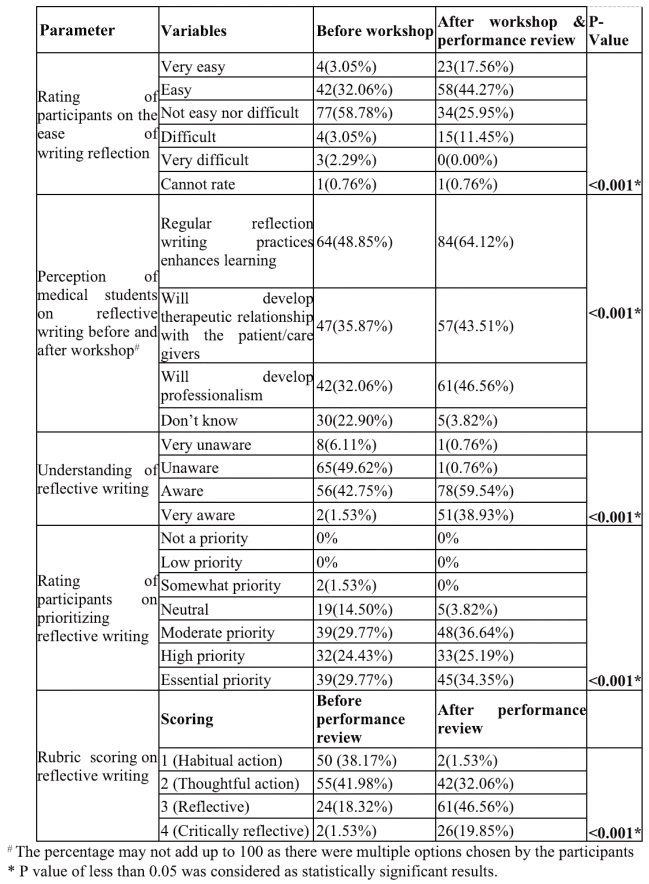
About 66% of the participants preferred to reflect immediately after the class, 17% during the class and 15% would like to write some days later. About 34% strongly agreed that mastering reflective writing skills will develop skills in critical analysis and eventually make them a better physician. The satisfaction survey mentioned that about 41% felt that the reflective writing training was very relevant to their learning. About 99% reported that they will use the inputs of the workshop for writing reflection in the future. Their reaction after writing reflection was good for 44% and very good for 42% of the participants. About 21% reported lack of adequate time in writing reflection and 15% felt that they don’t want their inner feelings to be exposed for others to read. There was a significant difference in writing reflection on rubric scoring before and after performance review and one-on-one feedback. There was also a significant difference between the rating of participants on the ease of writing reflection, perception of medical students on reflective writing before and after workshop, understanding of reflection writing, and the rating of participants on prioritizing reflection writing before and after workshop (Table 1).
Table 1 Analysis of various parameters before and after workshop (n-131)
This current study assessed the effect of workshop and review on reflective writing skills. Liu GZ et al’s study found that 39% of the students had positive perceptions after the workshop which supports our study finding that 42% reported very good perceptions after the workshop.7 This similarity may be attributed to comparable workshop designs, populations, or evaluation methods.
A systematic review by Lim JY et al and Singh et al recommended the need for training in impactful reflections.1,8 Our study reported that there was a significant difference in writing reflections before and after performance review, which reinstates the previous findings on the recommendations of training. This similarity might be due to the fact that any hands-on workshop will have an impact on the participants.
Our study reported that almost all of the participants felt that reflective writing had a positive impact on their learning. But Kamarudin et al found that reflective writing helped the students personally more than academically.9 The difference may stem from varying geographical locations, cultural influences on participants’ perceptions, and differing methods of measuring impact.
Workshop and performance review brought changes in reflective writing in terms of the description of the event, under ‘so what’ and ‘what next’ components, rather than concentrating on the ‘what’ component. This study demonstrates the importance of constructive feedback in the effective teaching of reflective writing skills. However, long term studies are essential to study the impact of feedback on students’ clinical decision-making skills. Our study’s limitation was a small sample size coming from a single center, potentially limiting the generalizability of findings.
Institute ethical committee approval was obtained (BIEC – 077 – 23) dated 31st August, 2023. Confidentiality was maintained throughout the period of the research
1. Lim JY, Ong SY, Ng CY, Chan KL, Wu SY, So WZ et al. A systematic scoping review of reflective writing in medical education. BMC Medical Education. 2023 Jan 9;23(1):12. DOI: https://doi.org/10.1186/s12909-022-03924-4
Crossref PubMed PMC
2. National Medical Mission. Competency-based undergraduate curriculum for Indian medical graduate. Logbook guidelines. 2019. Retrieved from https://www.nmc.org.in/MCIRest/open/getDocument?path=/Documents/Public/Portal/LatestNews/Logbook%20Guidelines_17.01.2020.pdf
3. Hedge, S., Dayanidhi, V. Feedback and guiding questions as tools for reflective writing: a comparative study among undergraduate medical students in India. BMC Medical Education 25, 2025; 1169 https://doi.org/https://doi.org/10.1186/s12909-025-07767-7
Crossref PubMed PMC
4. Preethi BP, Shubha DB, Babu S. Facilitating reflective writing as a professional development tool among medical students. Journal of Medical Sciences and Health 2025; 11(1):26–31. https://doi.org/10.46347/jmsh.v11.i1.24.91
Crossref
5. Wald, H.S., Borkan, J.M., Scott Taylor, J., Anthony, D., and Reis, S.P. Fostering and evaluating reflective capacity in medical education: Developing the REFLECT rubric for assessing reflective writing. Academic Medicine, 2012:87(1), 41–50. https://doi.org/10.1097/ACM.0b013e31823b55fa
Crossref
6. Rostami A, Keshmiri F, Askari R, Jambarsang S, Shafiei M. Validation of Groningen Reflection Ability Scale Questionnaire and evaluation of reflection ability level of healthcare management students. Evidence-Based Health Policy, Management Economics. 2019; 3(4): 293–302. DOI: https://doi.org/10.18502/jebhpme.v3i4.2071
7. Liu GZ, Jawitz OK, Zheng D, Gusberg RJ, Kim AW. Reflective writing for medical students on the surgical clerkship: oxymoron or antidote? Journal of Surgical Education. 2016 Mar–Apr;73(2):296–304. https://doi.org/10.1016/j.jsurg.2015.11.002
Crossref PubMed PMC
8. Singh P, Saxena S, Pandey ST, Dulloo P. Assessing the impact of the portfolio workshop and the use of the rubric matrix for reflective writing on medical faculty and students. Cureus. 2024 May 2;16(5):e59530. https://doi.org/10.7759/cureus.59530. PMID: 38826974; PMCID: PMC11144020
PubMed PMC
9. Kamarudin MA, Suji MI, Wen WZ, Kumar SN, Dafiruddin FA, Murfiz NQ, Besar MN, Salam A. Exploring medical students’ perspectives on reflective writing: A qualitative focus group study. Bangladesh Journal of Medical Science. 2025 Jan 7;24(1):87–96
Crossref
© Education for Health.
Education for Health | Volume 38, No. 4, October-December 2025